
Using the American Heart Association's PREVENT risk model, we built our Veevo heart age calculator and analyzed U.S. population data. We were quite surprised by the results.
We interviewed more than 20 patients with high cholesterol and explained their heart risk using the American Heart Association's PREVENT equations. But we found it was very hard for them to understand what those risk numbers meant.
We then interviewed 10 doctors and heard the same thing: their patients often do not fully understand what these risk numbers mean. As a result, many discontinue lifestyle changes and medications shortly after their doctor visits.
Heart disease remains one of the biggest health threats we face. It's silent and all around us. The Swedish SCAPIS study of around 30,000 adults showed how common silent disease can be in the general population. We wanted to help our users understand their heart health better.
So we decided to build a heart age calculator that turns risk into something simpler you can easily picture: a heart age. Then we tested it on U.S. national data using NHANES survey data from 2015 to 2023.
The story that emerged was surprising, and it points to a clearer path: we need earlier prevention.
Key finding
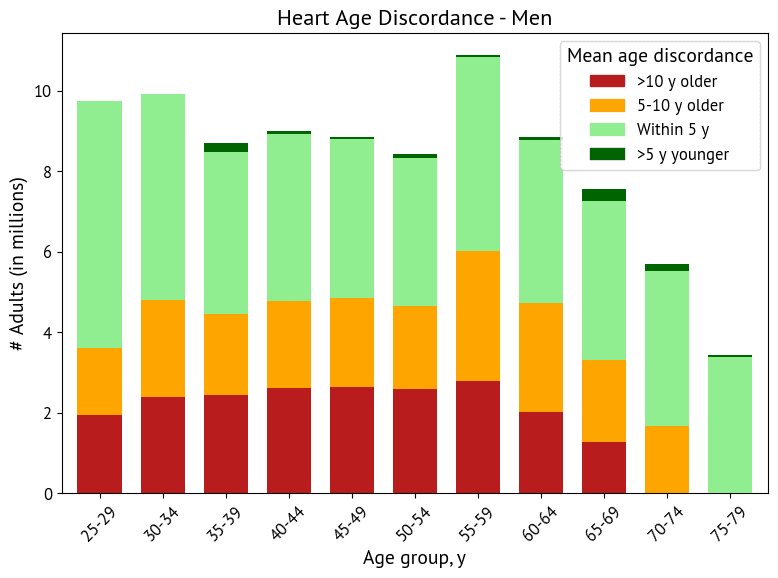
1 in 5 adults have a heart age 10+ higher than their current age
Using NHANES 2015-2023 data, 19.8% of adults ages 25-79 fall into the more-than-10-years-older category.
What does heart age mean?
Heart age answers a simple question: if a healthy person had your same predicted risk, how old would that person be? If you are 40 and your heart age is 50, your risk looks like that of a healthy 50-year-old.
We built our heart age approach using the methodology Dr. Michael Blaha used in his MESA heart age paper. But MESA is a much smaller cohort than the national datasets available today. The prevailing alternative has been the American Heart Association's Pooled Cohort Equations (PCE), introduced in 2013. PCE is still widely used by doctors, but it has two major issues: it includes race and it is based on older data.
In late 2023, Dr. Sadiya Khan and colleagues introduced PREVENT, a newer risk equation developed and validated using data from more than 6 million U.S. adults. It does not use race, and it can refine risk based on a person's average blood sugar (HbA1c) and kidney function (eGFR).
We decided to use the PREVENT equations and Dr. Blaha's heart age method to build our Veevo heart age calculator.
Read moreWhy do South Asians face a higher heart disease risk?How does our calculator estimate heart age?
- Calculate a person's 10-year heart disease risk using the PREVENT equations, tailored by sex.
- Build a healthy comparison profile for ages 25-80 using generally healthy adult values by age and sex, based on NHANES data and modern prevention targets.
- Find the age where that healthy person's risk matches the individual's risk.
That matched age is the estimated heart age.
Our in-depth analysis of U.S. population data
We used the large U.S. health survey run by the CDC called NHANES. CDC experts use sophisticated statistical methods to generate a representative dataset that includes age, sex, lab results, and more. We analyzed NHANES data from 2015 to 2023 and used survey weights so the results reflect the U.S. adult population.
To define a healthy comparison, we focused on people with no diabetes, no smoking history, a BMI under 30, systolic blood pressure under 140, and no blood pressure medication. For women, we allowed the blood pressure trend to shift around age 52 to reflect menopause.
The chart below shows the national picture for men.
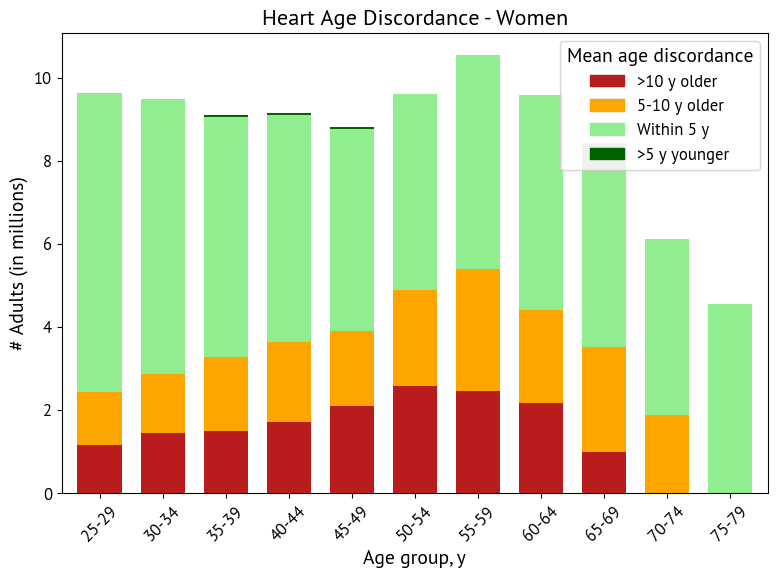
And here is a similar picture for women.
Our key findings
- About 1 in 5 adults have a heart age more than 10 years older than their actual age, and this is even more common in younger adults.
- Women show smaller gaps at younger ages, then similar gaps later in life.
- After age 65, the gap narrows because baseline risk rises for almost everyone.
We need to educate and engage people earlier, because the earlier we act, the more we can delay the onset of underlying problems such as plaque buildup in the heart arteries.
Read moreApoB vs LDL cholesterol: a practical navigation guideWhat comes next?
Our heart age is not a diagnosis, but we do think it is worth checking. We built a free tool on our website where you can enter your numbers and get an estimated heart age. We also provide a detailed breakdown of the factors that likely contributed to that estimate and the guideline-based targets for those factors.
At the end of the day, our heart age tool is a conversation starter. It helps you understand your health better and take action early so you can live a long, happy life with a healthier heart.
For a more comprehensive understanding of your heart health, you can also install our free app. It is available on the iPhone App Store and on Google Play.
Finally, heart age estimates your risk, but it can't show whether plaque has actually built up in your arteries. Seeing your arteries directly is what makes prevention personal, and we offer the Veevo Heart Scan for customers in the U.S. to do just that. You can Join the waitlist.
4 Sources
American Heart Association Development and validation of the PREVENT equations
https://pubmed.ncbi.nlm.nih.gov/37947085/SCAPIS Study Population-based coronary artery findings in Swedish adults
https://pubmed.ncbi.nlm.nih.gov/36356325/CDC NHANES National Health and Nutrition Examination Survey
https://wwwn.cdc.gov/nchs/nhanes/MESA Derivation of a coronary age calculator using MESA data
https://pubmed.ncbi.nlm.nih.gov/33663219/