
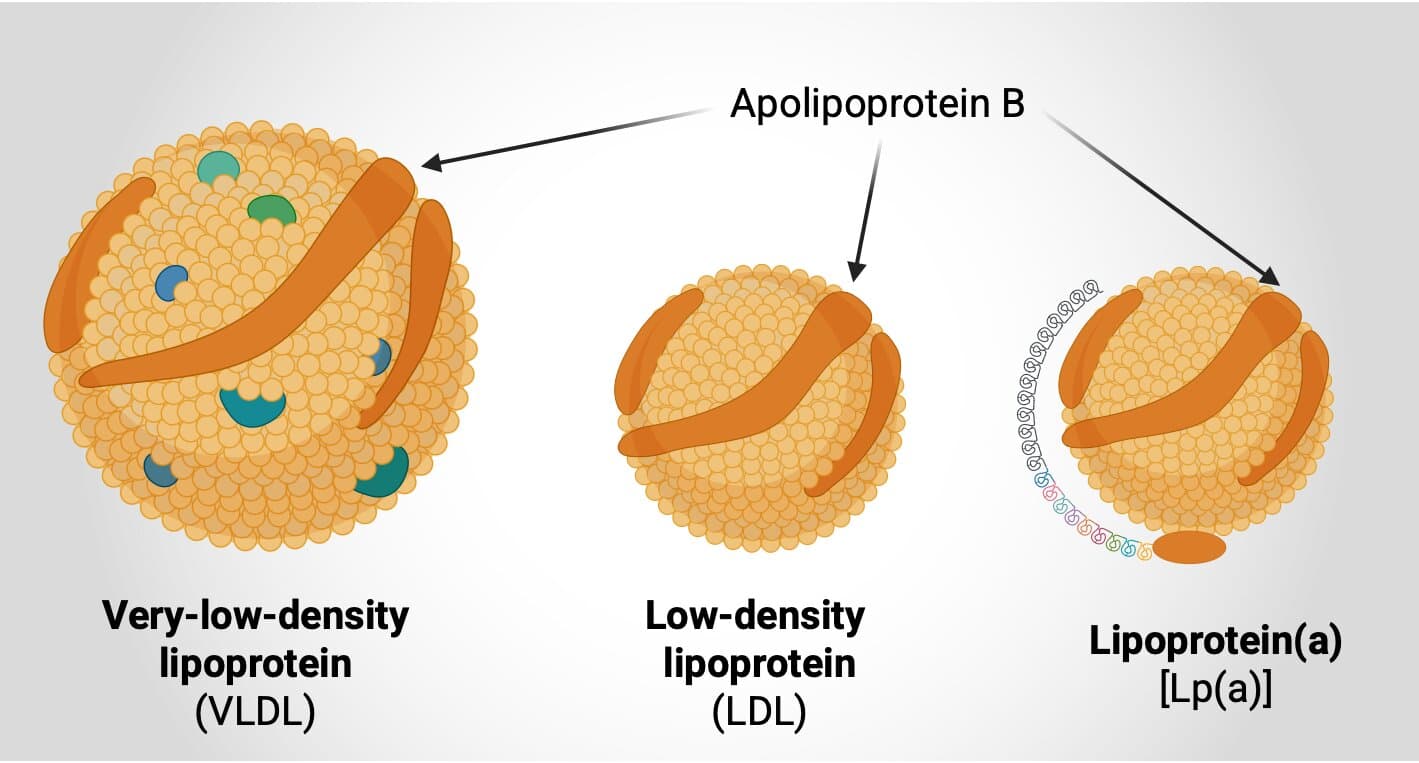
You have probably heard that ApoB is better than LDL cholesterol for heart attack or stroke risk. That is true. But chances are, you only have LDL cholesterol from a standard blood test and are wondering: are my LDL numbers good enough?
Plaque buildup in the arteries is driven by bad cholesterol particles. What matters is the total number of these particles. Both ApoB and LDL give you a picture of it.
The question is not “is ApoB better?” It is. The question is: “what do I do if I only have my LDL cholesterol number?”
The bad cholesterol garbage trucks analogy
A good way to understand the difference between LDL and ApoB is to consider your bloodstream as a highway. Think of bad cholesterol particles as garbage trucks. ApoB counts the number of trucks on the road. LDL cholesterol measures how much cargo those trucks are carrying.
What matters more for plaque buildup risk is the number of trucks, not the amount of cholesterol in them. One explanation: the bad cholesterol particles are of various sizes. The smaller particles carry less cholesterol but slip through artery walls easily. The bigger particles carry more cholesterol but have a harder time getting in. Their sizes balance out, and what matters in the end is the total number of particles. This is precisely what ApoB measures.
ApoB matters because two people can have the same LDL cholesterol but very different numbers of particles, if the average size of their bad cholesterol particles are different.
In fact, when ApoB and LDL cholesterol disagree, the mismatch in young adults predicts coronary artery calcium decades later. If you only have LDL measurements, it is recommended that you get tested for ApoB. In absence of it, here are a couple of things you can do.
Generally, LDL is not so bad
Even though ApoB is better, LDL cholesterol is still a reliable everyday tracking number. It is on every standard blood test. The 2026 U.S. guideline brought back LDL and non-HDL cholesterol goals, so those are still the numbers most treatment decisions are built around.
Most people’s numbers agree
For many people, LDL and ApoB tell the same story. When one goes up, the other goes up. When one comes down with treatment or lifestyle changes, the other follows. If you are healthy with normal triglycerides and not on statins, LDL cholesterol is most likely giving you a fair read.
LDL has practical advantages
It is on every standard blood test. It does not require a special order. It is cheaper. And it has decades of research behind treatment targets, which is why the 2026 U.S. guideline restored explicit LDL cholesterol treatment goals. Also, if your lab reports non-HDL cholesterol, pay attention to it. It costs nothing extra and newer data suggest it often tracks ApoB slightly better than LDL cholesterol alone.
When mismatch shows up
A mismatch between LDL cholesterol and ApoB is more likely in the following scenarios.
| Watch out if… | Why it matters | What to do |
|---|---|---|
| You have high triglycerides | LDL can miss extra ApoB particles | Use non-HDL cholesterol too, and consider ApoB |
| You have diabetes, high body weight, or prediabetes | LDL can look normal while ApoB is high | ApoB is more useful |
| Your non-HDL cholesterol is much higher than LDL | Suggests more bad cholesterol particles beyond LDL | Do not rely on LDL alone |
| You are on statins | LDL drops more than ApoB | Recheck ApoB |
| Your LDL targets are low (< 70 or < 55) | Small mismatches matter more | ApoB becomes more useful |
Where LDL can miss risk
The mismatch matters most when LDL looks “good,” not when it looks high.
| LDL cholesterol level | How much to rely on LDL alone |
|---|---|
| ≥ 100 mg/dL | LDL already signals risk |
| 70–99 mg/dL | Gray zone — ApoB can give you more clarity |
| < 70 mg/dL | Mismatch becomes more important |
| < 55 mg/dL | Mismatch becomes common |
This pattern comes from recent studies showing rising mismatch at lower LDL targets.
A simple non-HDL cholesterol check
Remnant cholesterol is your non-HDL cholesterol minus your LDL cholesterol. You can calculate it from numbers you already have. It captures bad cholesterol particles that are not LDL.
| Remnant cholesterol (mg/dL) | What it means |
|---|---|
| < 20 | Usually fine |
| 20–29 | Elevated level of non-LDL bad cholesterol particles |
| ≥ 30 | High level of non-LDL bad cholesterol particles. Caution zone. |
Approximate guides, not hard cutoffs. Remnant cholesterol predicts heart disease risk independent of LDL and ApoB (Varbo & Nordestgaard, 2021).
Should you test ApoB?
Yes. If you can, getting ApoB checked once is a smart reality check. It helps show whether your LDL cholesterol is giving a fair read on your particle count.
But do not think of one ApoB result as a lifetime conversion factor. ApoB can change over time, and mismatch can appear with start of a statin, start of diabetes, or significant weight change.
Read moreThe new heart health trio: ApoB, Lp(a), and coronary calcium scoreLDL cholesterol treatment goals
If you do not have ApoB, follow the guideline LDL cholesterol goals and use non-HDL cholesterol as your backup number.
| Status | LDL cholesterol goal | Non-HDL cholesterol backup | ApoB guide |
|---|---|---|---|
| Most adults with low or intermediate risk | < 100 mg/dL | < 130 mg/dL | ~ 90 mg/dL |
| Diabetes, calcium score > 100, or detected plaque | < 70 mg/dL | < 100 mg/dL | ~ 70 mg/dL |
| Past heart attack or stroke, diabetes + high blood pressure | < 55 mg/dL | < 85 mg/dL | ~ 60 mg/dL |
LDL and non-HDL cholesterol goals from the 2026 American Heart Association guideline. ApoB thresholds from the 2024 National Lipid Association expert consensus.
While you are at it: check your Lp(a)
The 2026 guideline recommends Lp(a) be measured at least once in adulthood. It is mostly inherited, changes very little, and high levels can raise risk even when the rest of the blood test looks fine.
| Lp(a) level | Lp(a) in mg/dL | Risk category |
|---|---|---|
| < 75 nmol/L | < 30 mg/dL | Normal |
| 75–125 nmol/L | 30–50 mg/dL | Borderline |
| 125–250 nmol/L | 50–100 mg/dL | High |
| > 250 nmol/L | > 100 mg/dL | Very high — roughly doubles heart disease risk |
The 2026 American Heart Association guideline uses ≥ 125 nmol/L (≥ 50 mg/dL) as the threshold for elevated Lp(a).
The practical approach
If you can, get ApoB and Lp(a) tested once. Repeat ApoB when things change.
If your LDL cholesterol and non-HDL cholesterol look good, your triglycerides are normal, and your weight and blood sugar are stable, LDL cholesterol is a reasonable tracking number.
If triglycerides are high, non-HDL cholesterol runs much higher than LDL cholesterol, you have diabetes, prediabetes, or high body weight, you started a statin, or you are aiming for LDL cholesterol below 70 or 55, it is worth checking ApoB directly.
That is the honest middle ground. ApoB is better. LDL cholesterol is still useful. And if ApoB is missing, you can still use LDL cholesterol well, as long as you know when to be more careful.
6 Sources
American College of Cardiology Discordance among ApoB, non-HDL cholesterol, and LDL cholesterol (2024 journal scan)
https://www.acc.org/Latest-in-Cardiology/Journal-Scans/2024/05/20/03/46/discordance-among-apobWilkins et al., Journal of the American College of Cardiology Discordance between ApoB and LDL cholesterol in young adults predicts coronary artery calcification (CARDIA study)
https://pmc.ncbi.nlm.nih.gov/articles/PMC6613392/Atherosclerosis Journal Mismatch analyses comparing LDL cholesterol, non-HDL cholesterol, and ApoB (2025)
https://www.atherosclerosis-journal.com/article/S0021-9150(25)00036-X/abstractCopenhagen General Population Study Remnant cholesterol predicts heart disease beyond LDL and ApoB (Varbo & Nordestgaard, 2021)
https://pubmed.ncbi.nlm.nih.gov/34293083/American Heart Association 2026 guideline on the management of cholesterol
https://www.lipid.org/nla/2026-accahamultisociety-dyslipidemia-guideline-releasedNational Lipid Association 2024 expert consensus on ApoB in clinical practice
https://www.lipid.org/practicetools/apob-expert-clinical-consensus