
Written by Arvind Srivastav
Updated
Lp(a) is a genetic cholesterol marker that can increase heart attack risk. Here's what your number means and what to do if it's high.
Written by Arvind Srivastav
Updated
Lp(a), pronounced L-P-little-a, is a genetic variation of LDL cholesterol that is a crucial piece of the puzzle of heart risk. Very few people have been tested for it, even though it's elevated in 1 in 5 people. It doesn't respond to diet or exercise, and most doctors don't test for it. But in 2026, the AHA and ACC recommended for the first time that every adult get tested at least once.
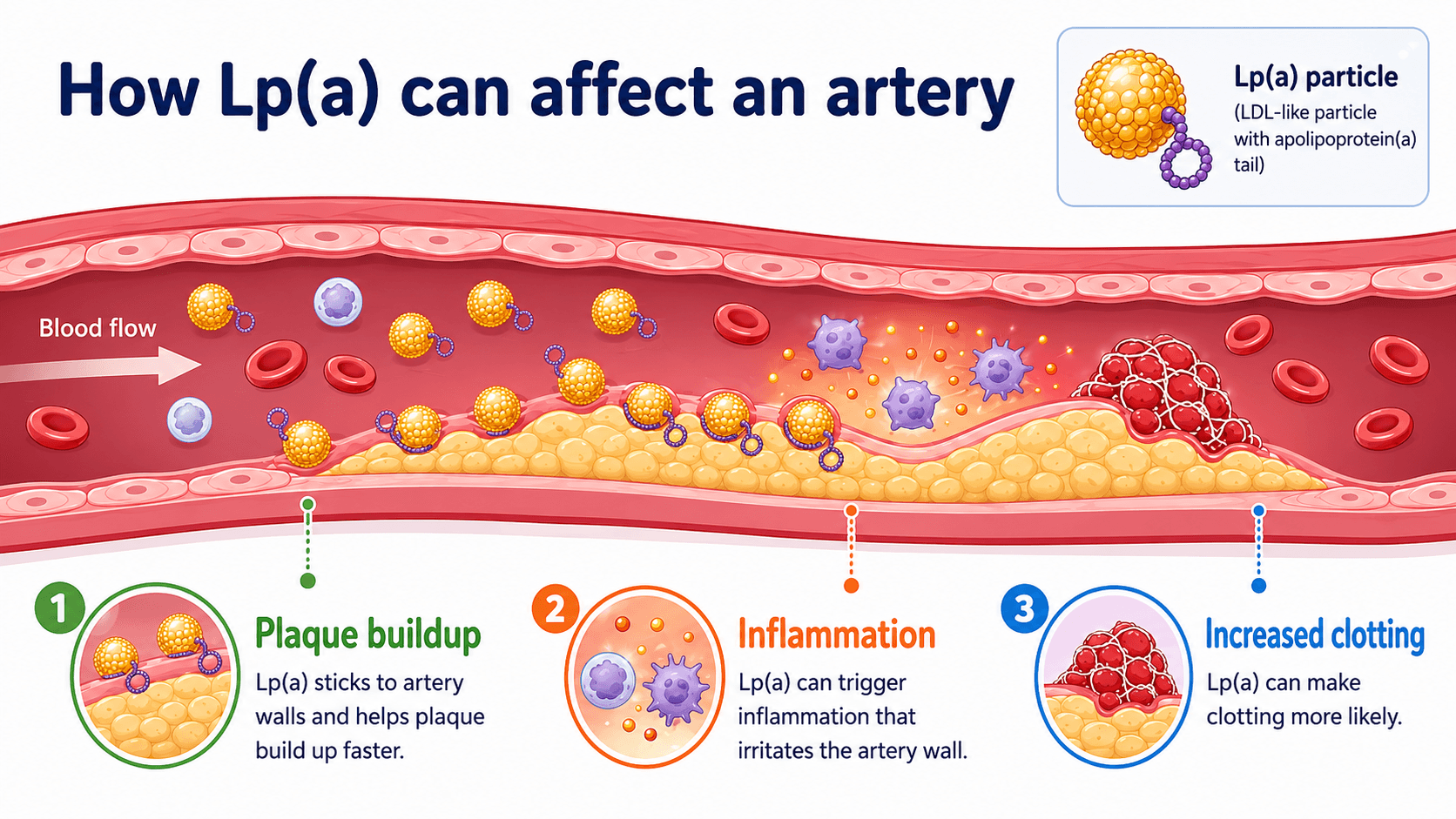
Lp(a) is an LDL particle with an extra protein called apo(a) attached to it. Think of regular LDL as a delivery truck carrying cholesterol through your blood. Lp(a) is the same truck, but with a sticky coating that makes it bind to artery walls more easily, trigger more inflammation, and resist your body's normal cleanup process.
This is what sets Lp(a) apart from regular LDL or ApoB. It's not just about how much cholesterol you're carrying. It's about a particle that's uniquely prone to causing damage.
| LDL-C | ApoB | Lp(a) | |
|---|---|---|---|
| What it measures | Cholesterol cargo in LDL particles | Total number of atherogenic particles | A specific genetic, sticky LDL particle |
| Can you change it? | Yes (diet, meds, exercise) | Yes (diet, meds, exercise) | No (over 90% genetic) |
| Part of standard lipid panel? | Yes | No | No |
| How often to test | Every 4–6 years | Once, then as needed | Once |
Labs report Lp(a) in two units. The preferred unit is nmol/L because it's more consistent across different lab methods. Here's how to read your number:
| Risk level | nmol/L | mg/dL | What it means |
|---|---|---|---|
| Normal | < 75 | < 30 | Low cardiovascular risk from Lp(a) |
| Borderline | 75–125 | 30–50 | Moderate risk; assess alongside other factors |
| Elevated | 125–250 | 50–100 | Increased risk; manage other risk factors |
| Very high | > 250 | > 100 | High risk |
Conversion between units is approximate because Lp(a) particle size varies between people. At 250 nmol/L and above, cardiovascular risk roughly doubles compared to normal levels.
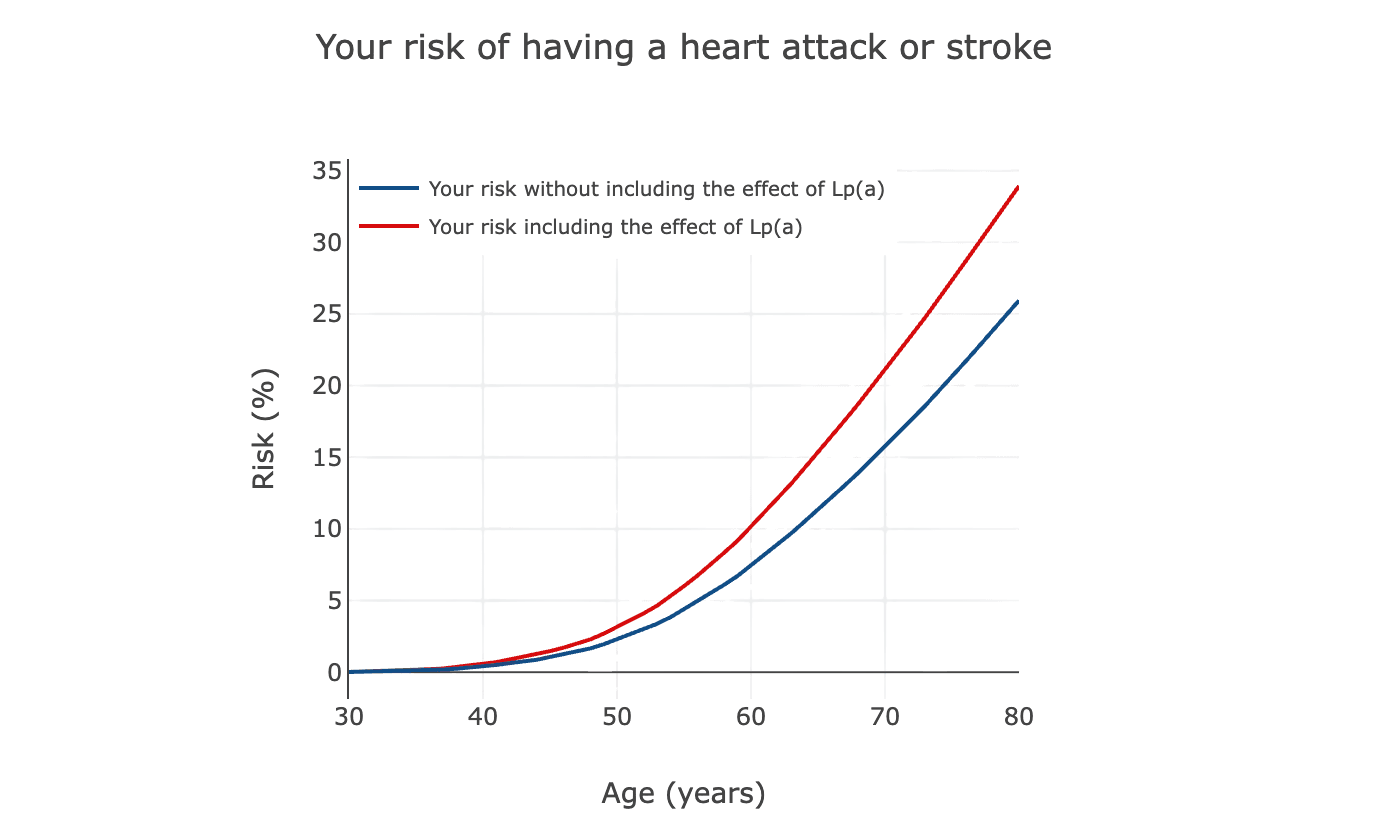
To see how your Lp(a) level affects your personal cardiovascular risk alongside other factors like blood pressure and LDL, you can use the Lp(a) clinical risk calculator.
Lp(a) increases your cardiovascular risk through three mechanisms:
Elevated Lp(a) also accelerates calcification of the aortic valve, increasing the risk of aortic stenosis over time. The risk is continuous: the higher the level, the higher the risk.
Risk slope
11%
Every 50 nmol/L above normal raises your cardiovascular risk by approximately 11%.
Over 90% of your Lp(a) level is determined by your genes. It's set at birth and generally stays stable throughout your life, though levels can shift during pregnancy, after menopause, or with kidney or thyroid disease. For most people, a single test gives you a reliable lifetime reading.
Lp(a) is strongly inherited. If yours is high, your parents, siblings, and children should get tested too. Levels also vary significantly across populations:
| Ancestry | Median Lp(a) | Relative level |
|---|---|---|
| Black / African descent | 75 nmol/L | Highest |
| South Asian | 31 nmol/L | Intermediate |
| White / European | 19 nmol/L | Low–moderate |
| Hispanic | ~16 nmol/L | Low–moderate |
| East Asian | 16 nmol/L | Lowest |
Median values from Lancet 2024. Individual levels vary widely within each group.
This guide is for educational purposes and is not medical advice. Please consult your doctor for personalized recommendations.
The 2026 ACC/AHA guidelines recommend that every adult get Lp(a) measured at least once. This is a Class I recommendation, the strongest level, and the first time US guidelines have endorsed universal Lp(a) screening.
Test earlier if you have a family history of heart attack before 55 (men) or 65 (women), a personal history of early heart disease, a diagnosis of familial hypercholesterolemia, or a family member with known elevated Lp(a).
Lp(a) is not included in a standard lipid panel. You need to ask your doctor to order it by name. Request "lipoprotein(a)" or "Lp(a)" specifically.
No fasting is required. It's a simple blood draw that can be added to any routine lab visit. Since Lp(a) is genetically determined, you generally only need to test once. Consider retesting if you go through menopause or are diagnosed with kidney or thyroid disease, as these can shift levels.
Today, no approved drug meaningfully lowers Lp(a).
However, hope is on the way. Five drugs in late-stage clinical trials are lowering Lp(a) by 80–98%. No Lp(a)-specific drug is FDA-approved yet, but the first results from large cardiovascular outcome trials are expected soon.
| Drug | Company | How it works | Lp(a) reduction | Phase 3 results |
|---|---|---|---|---|
| Pelacarsen | Novartis / Ionis | Antisense (monthly injection) | Up to 80% | Mid 2026 |
| Olpasiran | Amgen | siRNA (every 3–6 months) | 80–90% | 2028 |
| Lepodisiran | Eli Lilly | siRNA (every 6–12 months) | 94% | 2028+ |
| Zerlasiran | Silence Therapeutics | siRNA (2–3x per year) | 90–98% | 2028+ |
| Muvalaplin | Eli Lilly | Oral pill (daily) | 86% | 2028+ |
These drugs are investigational and not yet approved. Reduction percentages are from phase 2 trials.
Since you can't directly lower Lp(a) yet, the strategy is to lower every other risk factor more aggressively. Think of elevated Lp(a) as raising the bar on what counts as safe for everything else:
A coronary CT angiogram can be especially valuable when Lp(a) is elevated. Lp(a) drives soft (non-calcified) plaque that a calcium score alone can miss entirely.
One blood test, once in your life, tells you whether you carry a genetic risk factor that affects 1 in 5 people. If it's normal, great! If it's high, you can start reducing your other risk factors now for your long and healthy life. Either way, you're better off knowing.
2026 ACC/AHA Guideline on the Management of Dyslipidemia (Circulation)
Lipoprotein(a)
Lipoprotein(a): levels and testing
Lipoprotein(a) in clinical practice: what clinicians need to know
Lipoprotein(a) and cardiovascular disease (2024)
Lipoprotein(a) levels in disaggregated racial and ethnic subgroups
About lipoprotein(a)
Lipoprotein(a): an independent risk factor for cardiovascular disease
Lipoprotein(a) as a causal risk factor for cardiovascular disease
Lp(a) cardiovascular risk calculator