
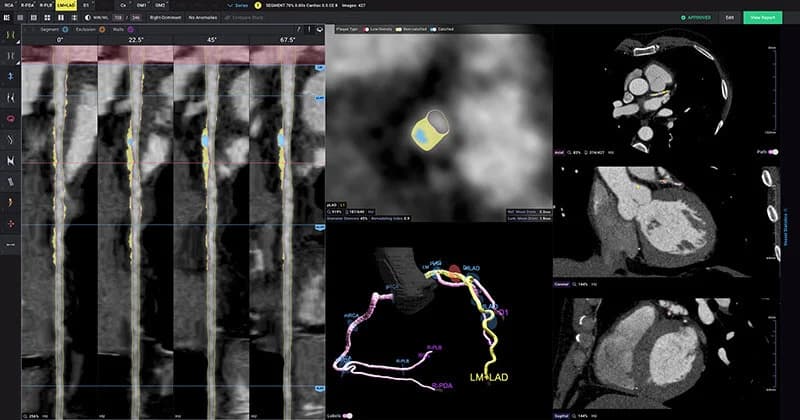
If you've looked into protecting your heart health, you may have come across Cleerly.
Cleerly is AI software that reads the images from a coronary CT angiogram heart scan. It then produces a detailed plaque analysis — far more detailed than a standard radiology report. This can be very helpful if you have a borderline or ambiguous result.
It sounds helpful. But is it worth the extra cost? Here's an honest, practical breakdown of what it does, what it measures, what it costs, how accurate it is, and who it makes the most sense for.
Key Takeaways
- Cleerly isn't a separate scan. It's AI software that analyzes the images from a coronary CT angiogram you've already had done.
- It measures plaque in far more detail than a standard read, including total plaque volume, a simple 0-to-3 stage, and how much of it is the soft, low-density type most linked to heart attacks.
- It adds the most value for borderline or ambiguous results. In Cleerly's own 750-patient trial, it changed how doctors managed more than 57 percent of patients. Medicare and several major insurers now cover it for cases like these, though out-of-pocket cost still varies widely.
- If you already have scan images and just want to see them, Veevo's free DICOM Viewer is a separate, simpler option that doesn't require a Cleerly analysis at all.
What Is a Cleerly Heart Scan?
Cleerly isn’t a heart scan in itself. Instead, it’s software that analyzes the images that come from heart scans. In other words, the benefit of Cleerly is the analysis, not the scan itself.
Specifically, it works with coronary CT angiograms, often shortened to CCTA or CTA. This is a non-invasive scan that takes detailed, three-dimensional pictures of your heart's arteries. The scan can reveal both soft and hard plaque, along with how much each artery has narrowed.
Here's how it works:
- You get a CCTA the same way you always would: lying in a CT scanner while contrast dye highlights your arteries on the images.
- A radiologist reviews those images and writes a report, the same as with any CCTA.
- Your images are sent through Cleerly's software for a second, AI-generated analysis.
Cleerly's software builds a 3D map of your coronary arteries from the same scan images. It then identifies, measures, and categorizes every area of plaque it finds. The result is a color-coded report showing where plaque sits, how much of it there is, and what type it is. That level of detail lets your doctor base your prevention plan on what's actually in your arteries, rather than on risk estimates alone.

Types of Plaque
Cleerly can tell you what type of plaque you have in your arteries. This is helpful because, while any plaque build-up is worth knowing about, some types are more concerning than others.
The main types of plaque include:
- Hard, calcified plaque, which tends to be stable.
- Softer, non-calcified plaque, which is more likely to rupture and trigger a heart attack.
- A subtype of soft plaque called low-density or vulnerable plaque, which carries the highest risk of all.
This matters because most heart attacks don't start at a significant blockage. About two-thirds begin in plaque that narrows the artery by less than half, and soft plaque is the type most strongly linked to heart attacks.
A standard CCTA report tells you whether plaque is there, roughly how much, and how narrow your arteries are. But it's largely a trained eye's estimate. Cleerly turns those impressions into measurements.
What Cleerly Measures
It's the difference between hearing "you have some plaque" and seeing exactly how much, what kind, and where. A Cleerly report typically covers:
- How much plaque you have in total. Cleerly adds up the plaque across all your coronary arteries and reports it in cubic millimeters, along with how much of your artery walls it takes up.
- Your plaque stage. Those totals are translated into a simple scale from 0 to 3: no plaque, mild, moderate, or severe. It's an easy way to understand where you stand and talk through next steps with your doctor.
- What kind of plaque it is. Rather than just labeling plaque hard or soft, Cleerly measures how much of each you have, including low-density plaque, the softest and highest-risk kind. Knowing the amount matters: in a large study of people with chest pain, it predicted heart attacks better than a calcium score or how narrow the arteries were.
- How narrow each artery is. Narrowing is calculated by software along the length of each artery, rather than estimated by eye.
- Whether blood flow is affected. An optional, FDA-cleared add-on called Cleerly ISCHEMIA estimates whether any narrowing is likely limiting blood flow to your heart, which can spare some people an extra test.

How Does Cleerly's Analysis Differ From a Standard CCTA Report?
Since the CCTA scan itself is identical either way, the difference comes down to how thoroughly the images get analyzed afterward.
| Category | Standard CCTA read | CCTA with Cleerly analysis |
|---|---|---|
| Narrowing | Estimated by eye | Measured by software along each artery |
| Overall plaque amount | A broad category, from mild to extensive | Total plaque volume in cubic millimeters, plus a stage from 0 to 3 |
| Plaque type | Calcified, non-calcified, or mixed, with high-risk plaque flagged when seen | The amount of each type, including low-density (highest-risk) plaque |
| Blood flow | Not assessed | Optional FDA-cleared ISCHEMIA analysis estimates whether narrowing limits blood flow |
| Consistency between readers | Can vary from one radiologist to another | Standardized, reproducible output |
| Tracking changes over time | Hard to compare scans precisely | Numeric measurements make comparison easier |
| Report format | Text-based radiology report | Color-coded 3D visual report plus detailed metrics |
Research on Cleerly
In Cleerly's own CERTAIN trial, a 750-patient study across five United States sites, adding this analysis to a standard CCTA read changed how doctors managed more than 57 percent of patients. In other words, Cleerly made a practical difference to how doctors treated patients in more than half of the cases.
The same trial found a 37 percent drop in additional testing and a 28 percent rise in preventive medication use once doctors had the added detail.
They suggest the extra information changes clinical decisions, not just how a report looks on paper.
How Much Does a Cleerly Heart Scan Cost?
Pricing for Cleerly's analysis varies by imaging center, and neither Cleerly nor most providers publish a fixed national price.
Reporting on the field has cited out-of-pocket charges around $850 for the AI analysis alone at some practices, on top of the cost of the CCTA itself, which commonly runs from several hundred to around $1,500 or more depending on where you're scanned and whether insurance applies.
Because pricing isn't standardized, the most reliable way to know your actual cost is to ask your imaging center directly for both the CCTA and Cleerly analysis fees before you book. Ask whether Cleerly's analysis will be billed separately from the scan itself.
If you're comparing this to the cost of a CT angiogram with AI analysis more broadly, expect the same wide range, since pricing depends heavily on your imaging center and whether insurance applies.
Read moreIs a heart scan covered by HSA or FSA?Is Cleerly Covered by Insurance and Medicare?
Coverage for AI plaque analysis has expanded quickly, and this is an area worth double-checking with your own plan since it keeps changing.
Cleerly and Medicare Coverage
Medicare now has a dedicated billing code for this type of analysis, CPT 75577. This code was effective from the start of 2026, with a national payment rate of just over $1,000.
Coverage applies when specific criteria are met, generally:
- Chest pain without a known history of coronary artery disease
- A CCTA result in an intermediate range
- A cardiac workup that hasn't already confirmed or ruled out disease another way
It doesn't apply to:
- Routine screening
- A clearly normal CCTA
- Cases with a severe blockage already confirmed by other means
Ask your doctor's office to confirm your case fits Medicare's criteria before assuming it's covered.
Cleerly and Private Coverage
Private insurance coverage has grown substantially too. As of early 2026, Cleerly’s analysis is covered by major insurers including UnitedHealthcare, Cigna, and Aetna.
Coverage criteria and the insurers involved continue to change, so confirming directly with your insurer and your imaging center before scheduling is still the safest approach.
If your case doesn't fit standard coverage criteria, ask your imaging center about the out-of-pocket rate up front rather than after your scan.
You can learn more on Cleerly’s coverage page.

How Accurate Is a Cleerly Heart Scan?
Cleerly's AI analysis has been tested directly against experienced human readers, and the results are strong, though it's worth understanding exactly what was measured.
In a study comparing Cleerly's software to radiologist assessment for detecting significant blockages (50 percent or more narrowing), the AI scored 0.91 on a measure of overall diagnostic accuracy called AUC, where 1.0 would be perfect, compared with 0.77 for an experienced human reader. In plain terms, the software was noticeably better at correctly separating patients who did and didn't have significant blockages than the human comparison group in this particular study.
Of course, it’s important to notice the limits of the study. It's only one study, comparing Cleerly's software to a specific group of human readers, using a specific reference standard. It shows the software performs very well in that comparison. But that doesn't mean every human radiologist will be outperformed by this margin, or that AI analysis replaces a doctor's judgment about your overall care.
Cleerly's analysis is intended to add detail to a radiologist's read, not substitute for one.
Read moreCleerly vs HeartFlow: how two AI heart scan tools compareIs a Cleerly Scan Worth It?
If cost isn't the deciding factor, the added detail is quite useful for a meaningful share of patients. But it doesn't add much for everyone, and knowing which situation you're in matters more than the price tag.
Cleerly's analysis tends to add the most value if you:
- Have a borderline or ambiguous standard CCTA result and want a clearer picture of exactly what kind of plaque you have.
- Have risk factors such as a high Lp(a) result, a strong family history of heart disease, or high cholesterol, and want to know whether you're carrying the higher-risk, low-density type of plaque specifically.
- Want a second, independently generated read before deciding on next steps with your doctor.
- Want a clear baseline, so a future scan can show whether your treatment is slowing, stabilizing, or even shrinking your plaque.
You may not need it if:
- Your standard CCTA already came back clearly normal.
- Your standard CCTA already shows severe blockage that clearly needs treatment.
The CERTAIN trial result is worth repeating here because it's the clearest evidence available: in that 750-patient study, adding Cleerly's analysis changed clinical management in more than half of cases and increased physicians' diagnostic confidence roughly five-fold compared with a standard read alone.
This strongly suggests that Cleerly makes an actual, practical difference to how your health is managed.
Read moreLipoprotein(a) or Lp(a): What It Is and What Your Levels MeanVisualize Your CCTA Scan Result
If you've already had a coronary CT angiogram, whether through Cleerly or not, you may simply want to see your own scan images rather than commission a new AI analysis. That's a separate, much simpler thing to do, and it's free.
Your imaging center holds your original CCTA images in a format called DICOM, the standard file type medical scans are stored in. Most imaging centers will provide these to you on request, either burned onto a CD or as digital files you can download.
Once you have those files on your computer, you can sign in and upload a DICOM file, folder, or ZIP archive to Veevo's free DICOM Viewer to view your own scan images directly. This is purely a way to look at images you already have. It's separate from AI plaque analysis and from medical interpretation of your results, both of which should still come from a qualified doctor.
Frequently Asked Questions
Often, yes, when specific clinical criteria are met. As of early 2026, major private insurers including UnitedHealthcare, Cigna, and Aetna cover Cleerly's plaque analysis for patients with chest pain and a borderline CCTA result, together covering more than 86 million Americans. Coverage isn't universal, so confirm your specific plan and case with your insurer before scheduling.
Yes, under specific conditions. Medicare created a dedicated billing code, CPT 75577, for this analysis effective at the start of 2026, paying a national rate of just over $1,000. Coverage generally requires chest pain without known coronary artery disease, a borderline CCTA result, and a cardiac workup that hasn't already resolved the question another way. It doesn't cover routine screening or cases where the CCTA is already clearly normal or clearly severe.
It depends on your CCTA result and your risk factors. It tends to add real value for borderline or ambiguous results, or if you have risk factors like high Lp(a) or a strong family history and want to know your specific plaque type. It adds less for a clearly normal result or one that already shows severe blockage, since the standard read already answers the key question in those cases.
Cleerly's analysis is only available through imaging centers that offer it alongside a coronary CT angiogram, so start by asking whether a facility performing your CCTA also offers Cleerly's analysis, or ask your doctor for a referral to one that does. Availability varies by region, and confirming both the analysis and your insurance coverage with the specific imaging center before booking will save you a follow-up call later.
The Bottom Line on Cleerly
A coronary CT angiogram already gives you and your doctor a strong picture of your heart health. Cleerly's analysis adds a level of detail, exact plaque volume and type, that a standard read alone doesn't capture, and the evidence so far shows that added detail can genuinely change how doctors manage borderline cases.
Whether it's worth adding for you comes down to your specific result, your risk factors, and what your insurance will cover, all of which are worth a direct conversation with your doctor and imaging center rather than a one-size-fits-all answer.
If you already have scan images from a CCTA, you don't need a new analysis just to see them. Veevo's free DICOM Viewer lets you view your own images directly, whenever you're ready.
12 Sources
Aetna. (2026). Aetna approves coverage for Cleerly's AI cardiovascular imaging analysis.
https://cleerly.com/press/aetna-approves-coverage-for-cleerlyBernardo R, Nurmohamed NS, Bom MJ, et al. (2025). Diagnostic accuracy in coronary CT angiography analysis: artificial intelligence versus human assessment. Open Heart.
https://doi.org/10.1136/openhrt-2024-003115Cigna. (2025). Cigna approves coverage for Cleerly's AI cardiovascular imaging technology.
https://www.businesswire.com/news/home/20250924211492/en/Cigna-Approves-Coverage-for-Cleerlys-AI-Cardiovascular-Imaging-TechnologyCleerly. (2024). Cleerly announces CERTAIN multicenter clinical trial results.
https://cleerly.com/press/cleerly-announces-certain-clinical-trial-resultsCleerly. (2026). Costs and coverage for Cleerly plaque and ISCHEMIA analysis.
https://cleerly.com/costs-coverageCleerly. (2024). Medicare Administrative Contractors approve coverage of Cleerly heart scans.
https://cleerlyhealth.com/press/mac-coverage-ai-plaque-analysisCleerly. (2024). Cleerly launches Cleerly ISCHEMIA solution for heart disease analysis.
https://cleerlyhealth.com/press/cleerly-launches-ischemia-heart-disease-analysisCury RC, Leipsic J, Abbara S, et al. (2022). CAD-RADS 2.0: Coronary Artery Disease-Reporting and Data System, an expert consensus document. JACC: Cardiovascular Imaging.
https://pubmed.ncbi.nlm.nih.gov/36115815/Falk E, Shah PK, Fuster V. (1995). Coronary plaque disruption. Circulation.
https://pubmed.ncbi.nlm.nih.gov/7634481/Min JK, Chang HJ, Andreini D, et al. (2022). Coronary CTA plaque volume severity stages according to invasive coronary angiography and FFR. Journal of Cardiovascular Computed Tomography.
https://pubmed.ncbi.nlm.nih.gov/35379596/STAT News. (2025). Medicare to cover $1,000 AI heart scans. Will cost match benefits?
https://www.statnews.com/2025/11/11/medicare-coverage-ai-heart-scans-heartflow-cleerly-elucid/Williams MC, Kwiecinski J, Doris M, et al. (2020). Low-attenuation noncalcified plaque on coronary computed tomography angiography predicts myocardial infarction: results from the multicenter SCOT-HEART trial. Circulation.
https://pubmed.ncbi.nlm.nih.gov/32174130/