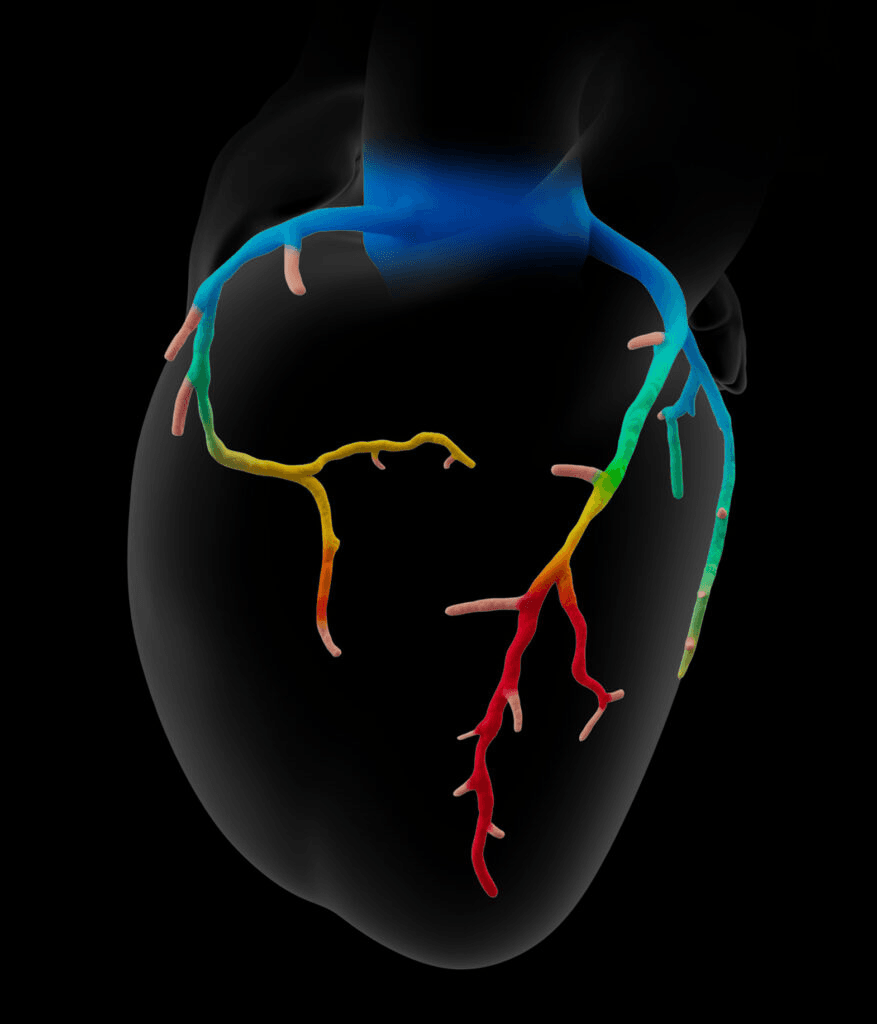
If you're interested in a CT angiogram heart scan, you might have heard about HeartFlow. It's an AI software that can tell whether a blockage in your heart arteries is actually reducing blood flow. That is a question that used to require an invasive catheterization to answer. Now it can be done from a scan you may have already had.
What does HeartFlow do?
HeartFlow takes images from a coronary CT angiogram and builds a 3D model of your arteries. Then it runs a virtual simulation of blood flow through that model. The result is a measurement called FFR-CT (fractional flow reserve from CT). It tells your doctor whether a blockage is limiting blood flow to your heart muscle, or if blood is getting through just fine despite the narrowing.
Why does that matter? Because not every blockage is an immediate risk. An artery can look 50 percent narrowed on a scan, but blood flow may still be adequate. Without a way to check flow, doctors sometimes send patients for invasive procedures they did not need. HeartFlow helps avoid that.
HeartFlow received FDA clearance in 2014, making it the first AI cardiac imaging tool cleared in the United States. Its diagnostic accuracy was validated in the NXT trial, which found an 86% accuracy rate for identifying blockages that restrict blood flow.
Read moreWhat does a CT angiogram show?HeartFlow FFR-CT vs invasive catheterization
Before HeartFlow, the only way to measure blood flow past a blockage was invasive FFR. A cardiologist threads a catheter with a pressure wire into your arteries, injects a drug to stress the heart, and takes measurements. It works, but it carries real risks and costs. HeartFlow gives doctors similar information from a CT scan you have already completed.
HeartFlow FFR-CT vs invasive catheterization
| HeartFlow FFR-CT | Invasive catheterization | |
|---|---|---|
| What it measures | Blood flow restriction from CT images | Blood flow restriction with a pressure wire |
| How it works | AI builds a 3D model and simulates flow | Catheter threaded into arteries |
| Invasive? | No. Uses existing CT scan data | Yes. Requires sedation and arterial access |
| Risks | None beyond the original CT scan | Bleeding, infection, blood vessel damage, stroke (rare) |
| Typical cost | About $1,000 | $4,000 to $10,000+ |
| Recovery time | None | Several hours to a day |
| When it is used | After CT angiogram shows a moderate blockage | When intervention (stent) may be needed, or FFR-CT is inconclusive |
Invasive catheterization remains the gold standard and is necessary when a stent or other intervention is planned.
It is not just blood flow anymore: HeartFlow plaque analysis
In September 2025, HeartFlow launched a next-generation plaque analysis platform cleared by the FDA. This means HeartFlow can now do two things from a single CT scan: check whether blockages restrict flow and analyze the plaque itself.
Plaque analysis identifies what the buildup in your arteries is made of. Hard, calcified plaque is generally stable. Soft plaque is riskier because it can rupture and trigger a heart attack. In the REVEALPLAQUE study, HeartFlow's plaque analysis showed 95% agreement with invasive imaging (IVUS), the gold standard.
This combination of flow simulation and plaque characterization makes HeartFlow more useful than when it launched. Your doctor can now get a comprehensive picture of both what your plaque looks like and whether it is causing problems, all from one non-invasive scan.
Read moreCleerly vs HeartFlow: how two AI heart scan tools compareHow much does HeartFlow cost?
The HeartFlow FFR-CT analysis has a Medicare payment rate of about $1,017 as of 2025. The newer plaque analysis service has a separate payment rate of about $950. These are on top of the cost of the CT angiogram itself.
If you are paying out of pocket, expect the full package (CT scan plus AI analysis) to run roughly $1,500 to $3,000 depending on location and which analyses are ordered. That is still a fraction of what an invasive catheterization would cost ($4,000 to $10,000+), especially when you factor in the hospital stay and recovery.
Is HeartFlow covered by Medicare?
Yes. HeartFlow's FFR-CT analysis has been covered by Medicare since it received its own billing code (CPT 75580). In January 2026, AI plaque analysis also received a Category I Medicare billing code (CPT 75577), making both HeartFlow services covered.
On the private insurance side, coverage has expanded quickly. UnitedHealthcare and Cigna both cover HeartFlow plaque analysis. Several Blue Cross Blue Shield plans cover the FFR-CT analysis as well. If your doctor orders it and documents that a CT angiogram showed a moderate blockage, most insurers will cover the HeartFlow analysis.
Read moreIs a heart scan covered by HSA or FSA?How reliable is HeartFlow's technology?
HeartFlow has been through more clinical validation than most cardiac AI tools. Three key studies back it up.
- NXT trial — 254 patients across 10 centers. HeartFlow FFR-CT had 86% diagnostic accuracy for identifying blockages that restrict blood flow, compared to 65% for CT angiogram alone.
- PLATFORM trial — 584 patients. Using HeartFlow reduced unnecessary catheterizations by 83% and cut costs by 33%. Zero cancelled patients had a heart event at one year.
- REVEAL PLAQUE study — 258 patients across 15 sites. HeartFlow's plaque analysis showed 95% agreement with invasive imaging for measuring total plaque volume.
The technology does have limitations. Heavy calcium deposits or motion artifacts on the CT scan can reduce accuracy. And when the result falls in a borderline range (FFR-CT between 0.76 and 0.80), your doctor may still recommend an invasive catheterization to get a definitive answer.
Who should consider a HeartFlow analysis?
HeartFlow is most useful when a CT angiogram finds a moderate blockage, roughly 30 to 70 percent narrowing. In those cases, the big question is whether the blockage actually restricts blood flow. That answer determines whether you need medication management or an intervention like a stent.
- You had a CT angiogram that showed a moderate blockage and your doctor wants to know if it restricts flow.
- Your doctor is considering an invasive catheterization and wants to see if it can be avoided.
- You have stable chest pain and want a comprehensive, non-invasive evaluation before committing to more aggressive testing.
HeartFlow is not a screening tool. It is ordered after a CT angiogram finds something that needs further evaluation. The starting point for most people concerned about heart health is getting that CT angiogram in the first place. That scan reveals plaque buildup, blockages, and artery health in one quick, non-invasive test.
The bottom line
HeartFlow turns a standard CT angiogram into something more powerful. It can tell you whether a blockage is actually restricting blood flow and what your plaque is made of, all without an invasive procedure. It is covered by Medicare and increasingly by private insurance. And it has strong clinical evidence behind it.
But HeartFlow only works if you have had a CT angiogram first. If you are thinking about your heart health, that scan is the logical starting point. It can catch problems years before they cause symptoms.
6 Sources
HeartFlow PLATFORM Trial Shows HeartFlow Analysis Decreases Invasive Diagnostic Testing
https://www.heartflow.com/press-release/platform-trial-shows-Heartflow-analysis-decreases-invasive-diagnostic/Journal of the American College of Cardiology Diagnostic Performance of Noninvasive Fractional Flow Reserve Derived From Coronary CT Angiography: The NXT Trial
https://pubmed.ncbi.nlm.nih.gov/24486266/European Heart Journal - Cardiovascular Imaging Prospective deep learning-based quantitative assessment of coronary plaque by CT angiography compared with IVUS: the REVEALPLAQUE study
https://academic.oup.com/ehjcimaging/article/25/9/1287/7663685HeartFlow FDA 510(k) Clearance and Launch of Next Generation HeartFlow Plaque Analysis Platform
https://ir.heartflow.com/news-releases/news-release-details/heartflow-announces-fda-510k-clearance-and-launch-nextHeartFlow De Novo FDA Clearance for Breakthrough FFRCT Technology (2014)
https://ir.heartflow.com/news-releases/news-release-details/heartflow-secures-de-novo-clearance-us-food-and-drugCardiovascular Business HeartFlow's AI-powered CAD offering receives new CPT code with improved reimbursement rate
https://cardiovascularbusiness.com/topics/healthcare-management/healthcare-economics/heartflows-ai-powered-cad-offering-receives-new-cpt-code-improved-reimbursement-rate